

How to Check If Chicken Eggs Are Fertile Step by Step
To check if chicken eggs are fertile, wait about 4 to 7 days after incubation and use a bright light in a dark room to candle the eggs. This method helps identify fertilization by revealing the development inside the egg.
Hold the light behind the egg and look for network-like veins or blood vessels, which confirm embryo development. Absence of veins usually means the egg isn’t fertile.
Handle the eggs gently to avoid harm. If you want to learn more about fertilization and tips for improving hatch rates, keep exploring this topic.
How Chickens Fertilize Eggs Before Laying

Before a hen lays an egg, a rooster must mate with her to transfer sperm into her reproductive tract. Once inside, the sperm can be stored in the hen’s oviduct for up to two weeks, so multiple eggs can be fertilized during this time.
A rooster mates with a hen to transfer sperm, which can fertilize multiple eggs over two weeks.
When the hen ovulates, her ovary releases a yolk that travels through the oviduct. If sperm are present, fertilization occurs in the infundibulum before the shell forms around the egg.
This means the egg you see laid by a hen can be fertilized or not, depending on whether mating happened. A broody hen will usually sit on fertilized eggs, incubating them until chicks hatch, but unfertilized eggs laid without a rooster’s involvement won’t develop into chicks.
Understanding this helps you know why fertilized eggs matter.
How and When to Candle Chicken Eggs for Fertility

Once eggs are laid, you’ll want to check if they’re fertilized by candling them between days 4 and 7 of incubation. In a dark room, hold a bright light behind each egg to see inside. If you spot veining or visible blood vessels, that confirms a fertilized egg and embryo development is underway.
A clear yolk without veining usually means the egg isn’t fertile. Handle the eggs gently during candling to avoid harming the yolk or embryo, and turn them carefully as you inspect. This early candling helps you assess chick viability by identifying which eggs are developing properly.
Keep in mind, candling eggs again later, around day 10 to 14, will allow you to monitor ongoing embryo progress and ensure healthy growth.
Visual Signs of Fertile Chicken Eggs Without Cracking
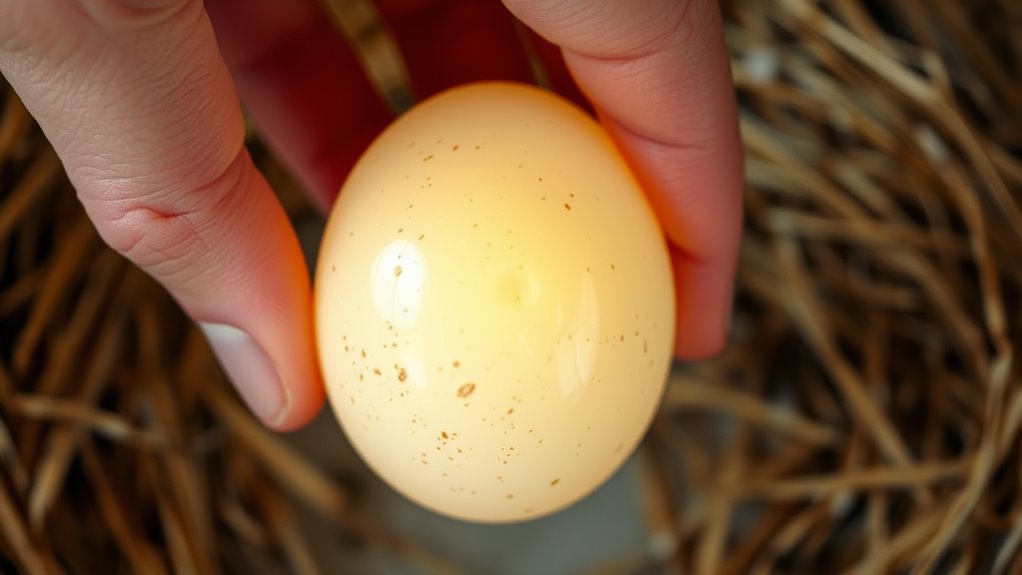
Although you can’t determine fertility by looking at the egg’s shell, you can identify fertile chicken eggs without cracking them by carefully examining the yolk’s internal features through candling. During egg inspection, focus on spotting the germinal disc—a small, distinct white spot on the yolk that’s more pronounced in a fertilized egg.
As development progresses, candling around day four reveals veining or blood vessels branching from the germinal disc, clear internal signs of life. These features aren’t visible externally, so candling remains your best non-invasive method.
If you see veining or a bulls eye ring near the germinal disc, you’re likely holding a fertile egg. Rely on these internal signs during candling to accurately assess fertility without cracking the egg open.
Confirming Fertility During Early Incubation
Candling eggs around day four lets you confirm fertility by revealing early embryo development. When you candle eggs during incubation, look for veins in eggs—these visible blood vessels indicate fertilized eggs with growing embryos. Detecting fertility at this stage is vital to guarantee you’re incubating viable eggs.
If you don’t see veins or embryo shadows, the eggs are likely unfertilized or non-viable. To get accurate results, store eggs in a dark room and use a bright light for candling eggs. Handle them gently to avoid damage and maintain reliability in your observations.
This method gives you a clear, early indication of which eggs are developing properly, helping you manage your incubation process effectively.
Tips to Get More Fertile Chicken Eggs
To increase the number of fertile chicken eggs, you need to focus on managing your flock’s mating conditions and health. Make sure you have a healthy rooster present, as hens need consistent access to him to lay fertile eggs. Isolate hens with roosters for at least 30 days to maximize the chance that eggs are fertilized.
Watch for mating behaviors like mounting to know when fertilization occurs. Maintaining good nutrition and overall health for both hens and roosters improves fertility and egg quality. If you want to tell if an egg is fertile, candling after a few days can help you know how to tell.
Frequently Asked Questions
How Do You Check Chicken Eggs for Fertility?
You check chicken eggs for fertility by candling them with a bright light in a dark room around day four.
Look for visible veins or a white bulls-eye on the yolk, indicating the egg is fertilized.
How to Tell if an Egg Is Fertilized With a Flashlight?
You hold the egg up to a bright flashlight in a dark room, rotate it gently, and look for veins or a spiderweb pattern inside.
If you see these, the egg’s fertilized; if not, it’s likely unfertilized.
Is There a Way to Check if an Egg Is Fertilized?
You can’t just ask the egg politely if it’s fertile. Instead, you’ll want to candle it after a few days of incubation to spot veins or embryo growth—there’s no magic, just patience and a flashlight.
Is the Egg Float Test Actually Accurate?
No, the egg float test isn’t accurate for fertility. You can’t rely on it because floating mainly reflects egg age, not fertilization.
To confirm fertility, you’ll need other methods like candling or incubation.
Conclusion
Now that you know how to check if your chicken eggs are fertile, imagine holding a warm egg to the light, watching the faint web of veins come alive inside. With each careful candling, you’re uncovering the tiny spark of new life, a promise nestled within the shell.
By observing and caring thoughtfully, you’re not just collecting eggs—you’re nurturing the beginning of a flock, one fragile, hopeful egg at a time. Learning how to check if chicken eggs are fertile is an essential step in successful poultry breeding and raising healthy chicks.